
You already know which item you’re going to look up first. It’s probably the one you looked for this morning.
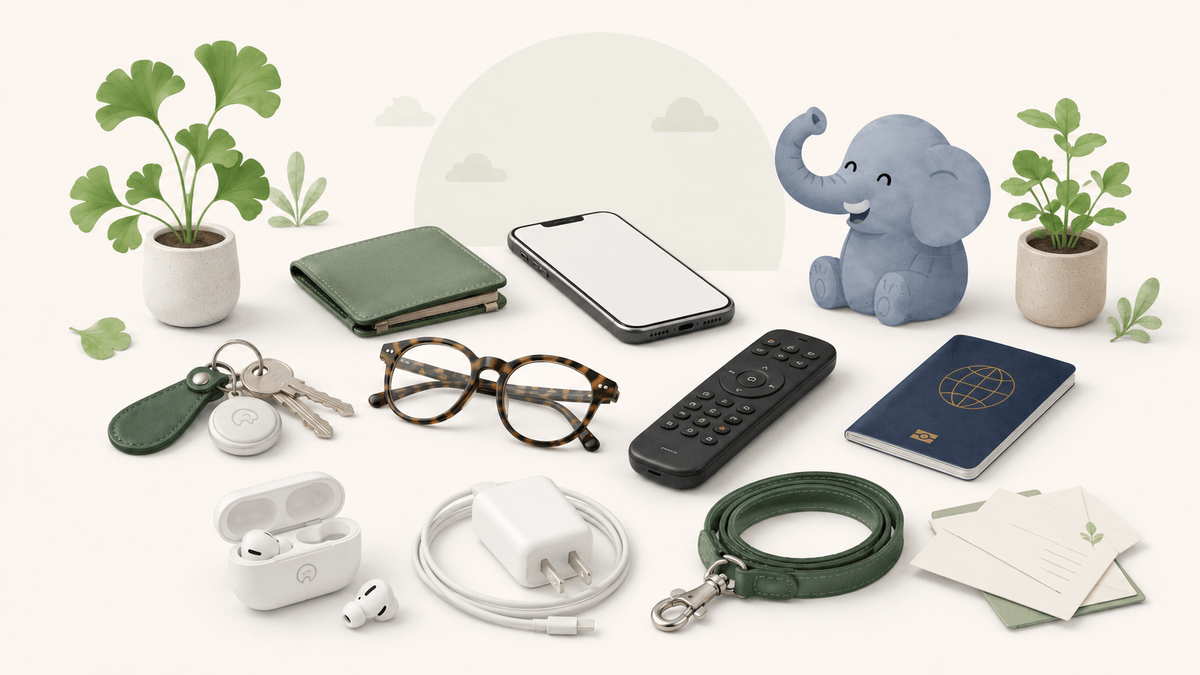
Here are the ten objects that get lost most frequently in the home, with specific advice for each.
The quick answer
Most things get lost at home for one of three reasons: they do not have a clear home, they are used by more than one person, or they move between rooms without anyone noticing. The best fix is usually not a complicated organising system. It is a small rule that everyone can remember, paired with a visible place to put the item back.
If you want to stop losing things at home, start with the items you search for most often. Give each one a single known location, make that location easier than the alternatives, and record the exceptions when an item has to live somewhere unusual.
1. Keys
The classic. Keys cause more daily frustration than any other mislaid object.
What works: A fixed spot with physical affordance, such as a bowl, a hook, or a tray, positioned right by the door you use most. Not near the door. Right by it. The goal is to make not putting them there the harder choice. Bluetooth trackers like Tile or AirTag help, but they are a backup, not a system.
2. Phones
Phones are frequently lost in the same room you’re in. We put them face-down on something and they disappear.
What works: Charging-location discipline. If your phone always goes to one of two places, such as bedside or a specific counter, the search space is tiny. The problem is usually the third location, wherever you put it when neither of those felt convenient. Either eliminate the third location habit, or use a retrieval aid such as a smart watch ping, Bluetooth tracker, or shared household note.
3. Reading glasses
Reading glasses are uniquely prone to being lost because they are removed in the same moment you stop being able to see well. That means you often cannot see clearly enough to find them once they are gone.
What works: Multiple pairs, positioned in every room where you typically need them. This sounds like a surrender, but it’s actually the most efficient solution. The glasses that are always on your bedside table are never lost.
4. TV remote controls
The remote falls down the back of something. It’s under a cushion. Someone moved it.
What works: Universal rule: remotes live on the arm or surface of whatever you sit to watch TV. Not anywhere else, ever. If this rule is followed by everyone in the household, the remote is essentially never lost. If it isn’t followed by everyone, a stick-on holder that attaches to the sofa or TV stand is worth the £4.
5. Scissors
Every household has scissors. Most households can’t find them when needed.
What works: One pair, one location, non-negotiable. A magnetic strip on the kitchen wall works well because it is visible, accessible, and the scissors are not hidden inside anything. If multiple family members need scissors independently, have one pair per floor, clearly designated.
6. Chargers and cables
Cables exist in a state of permanent diaspora, migrating between rooms, bags, drawers, and pockets.
What works: Fixed charging spots, with cables attached or stored there permanently. The cable that lives in the bag is separate from the cable that lives in the bedroom. They do not commute. When something new needs charging, it comes to the cable. The cable does not go to it.
7. Passports and important documents
The problem here isn’t frequency (you lose a passport rarely) but severity (losing a passport before travel is a significant problem).
What works: A single named location for important documents, such as a drawer, a folder, or a box, that is never used for anything else. Everything in that location is important and stays there. This needs to be known to everyone in the household who might need to find these documents independently.
8. Pen/pencil
Pens are consumed by the household at an extraordinary rate. They do not disappear; they scatter.
What works: Accept that pens scatter and compensate accordingly. A dedicated cup or pot in the kitchen with at least four pens in it creates a buffer. When the buffer gets low, it gets replenished. You’re never without a pen because you always have several in the right place.
9. Medication
Prescription and over-the-counter medication tends to be stored inconsistently: partly in the bathroom cabinet, partly in bags, and partly wherever it ended up last time.
What works: All medication in one location, with the exception of items that genuinely need to travel. A labelled box or basket makes it clear where to look. This is also important for households with children or elderly members who may need to find medication quickly and reliably.
10. That specific cable or adapter
The one that only works with the old camera, or the foreign plug adapter, or the specific charging brick for the thing you use twice a year.
What works: A single “unusual cables and adapters” box, accepted as permanent. Every unusual cable in the house goes in this box. When you need one, you go to the box. You might not know immediately which one you need, but you know where to start.
Why these objects are so easy to misplace
The common pattern is that these items sit between categories. Keys are used every day, but they move with you. Chargers belong to devices, but they also belong to rooms. Important documents are rarely needed, so nobody gets the benefit of daily repetition.
That is why the usual advice to “just put things away” does not help much. The real question is more specific: where should this item live when nobody is actively using it, and will everyone in the household understand that answer?
A simple home system that works
Use this quick process for any item you keep losing:
- Name the item in normal language, not a category.
- Choose one home for it.
- Make that home visible and easy to use.
- Tell the household the rule.
- Record the location somewhere searchable if the item is rare, shared, expensive, or awkward to describe.
You do not need to organise your whole house to get value from this. Fixing the top five things you lose most often can make daily life feel noticeably calmer.
Frequently asked questions
What is the most commonly lost item at home?
Keys, phones, glasses and remote controls are usually near the top. The exact answer depends on the household, but the cause is almost always the same: the item is put down while your attention is elsewhere.
How do I stop losing things around the house?
Give important items a fixed home, make that home easier than nearby alternatives, and write down exceptions. If something moves between rooms or gets used by several people, a shared searchable record is often more reliable than memory.
Is a tracker enough?
A tracker helps you recover an item, but it does not create a habit. The best setup is a fixed location first, then a tracker for the items that still move around.
The common thread across all of these: a fixed, known location that is used consistently and known to everyone who might need the object. That’s it. Not a complex system. Not labels. Not reorganisation. Just: this specific thing lives here, and everyone knows that.
Where this is not enough, for objects that move across the household, that are used by multiple people, or that have no obvious fixed home, a tool like Ginkgo fills the gap. But most of the objects on this list can be handled with a few intentional decisions about where they live.