
The AI home revolution has been promised many times. Smart fridges. Robot vacuums that navigate around your pets. Voice assistants that know what you need before you ask. Some of these have landed well. Many have not.
After a few years of living with AI tools in everyday contexts, it’s worth asking a more honest question than “what can AI do?” The better question is: where does AI actually reduce friction, and where does it add it?
The quick answer
AI is useful at home when it removes typing, searching, remembering, sorting, or admin. It is less useful when it tries to make personal decisions without enough context.
The strongest home AI use cases are practical and small: recognising objects from photos, finding things from vague descriptions, turning a voice note into a useful record, and summarising messy information. The weakest use cases are usually grand promises, such as predicting what your family needs, planning your life, or automating nuanced household decisions.
Where AI genuinely helps at home
Natural language search. This is perhaps the most underrated application. The ability to describe something in ordinary language, such as “the charger for the old camera” or “that thing we use to get lids off jars”, and get a useful answer is a genuine improvement over keyword search or browsing through categories. Natural language tolerates imprecision in a way that structured search does not. It is particularly good for objects you use rarely enough that you cannot remember the exact name.
Photo recognition. The ability to take a photo of an object and have it automatically identified and described, without you having to type anything, dramatically lowers the friction of documenting things. For home organisation especially, the step between “I own this” and “this is in my system” is often just too high when it requires manual entry. AI image recognition can close that gap.
Suggestion and pattern recognition. If you have been tracking something over time, AI can surface patterns you would not have noticed. Things that move frequently. Items that consistently end up in the wrong place. Consumables that tend to run out at a predictable rate. These suggestions are useful when they are grounded in your actual data, not generic recommendations.
Summarisation and synthesis. When you have a lot of mixed information, such as notes, photos, voice recordings and text, AI can surface what is relevant to a particular question without you having to search through everything manually. The key word is “relevant”: this only works well when the AI has a good model of what you are actually trying to do.
Where AI disappoints
Proactive intelligence without context. Many AI home systems promise to anticipate your needs. In practice, this often produces a stream of suggestions that are not relevant, or are relevant in a generic way that does not account for your specific situation. AI proactivity requires very good data about your context. Most systems do not have that data, and most people are not willing to provide it.
Automation of complex household tasks. Robotic systems that physically interact with the home, beyond well-defined tasks like vacuuming flat floors, are still far behind the promise. If you need nuanced physical manipulation, a good old drawer system is more reliable.
Understanding household relationships. Most AI systems are built for an individual user. Household dynamics are more complex: multiple people with overlapping but different knowledge, different habits, different mental models. AI that doesn’t account for this quickly becomes less useful in shared spaces.
Anything requiring deep preference learning. “Suggest a meal plan based on our preferences” sounds useful. In practice, household food preferences are complicated, contextual, and constantly changing. AI meal planning tends to either be too generic to be useful or require so much input to set up that the effort isn’t worth it.
The pattern behind the best AI home tools
Looking at the applications that actually deliver value, there’s a common thread: the AI is doing work the human would find tedious or error-prone, not trying to make complex decisions on the human’s behalf.
Recognising an object in a photo is tedious for a human. Matching a natural language description to a specific item in a database is error-prone without AI. Surfacing the right item from a large collection of loosely structured information requires intelligence that AI can genuinely provide.
Making judgements about what is important, what you need, or what you would prefer are areas where AI tends to overpromise, because they require the kind of deep contextual knowledge and nuanced reasoning that humans are still much better at.
A principle for evaluating AI home tools
Before adopting any AI home tool, it’s worth asking: what is this AI specifically better at than a non-AI alternative?
If the answer is “it recognises things I cannot easily type”, or “it finds things across a large unstructured collection”, or “it tolerates natural language instead of requiring exact queries”, that is a genuine answer. The AI is doing something it is meaningfully better at.
If the answer is “it predicts what I need” or “it makes decisions for me”, be sceptical. Not because AI cannot do these things at all, but because the quality of the output depends heavily on the quality of the input, and in home contexts the input is often sparse and ambiguous.
Questions to ask before adding an AI tool to your home
Before you buy or sign up for an AI home tool, ask a few plain questions:
- Does this save me from typing, searching, sorting, or remembering?
- Can I understand what data it uses?
- Can I correct it when it gets something wrong?
- Does it still work if the AI suggestion is imperfect?
- Would a simpler non-AI tool solve the same problem?
The best AI products do not require blind trust. They give you a useful first draft, a faster route to the answer, or a clearer way to retrieve information. You stay in control.
What this means for how we built Ginkgo
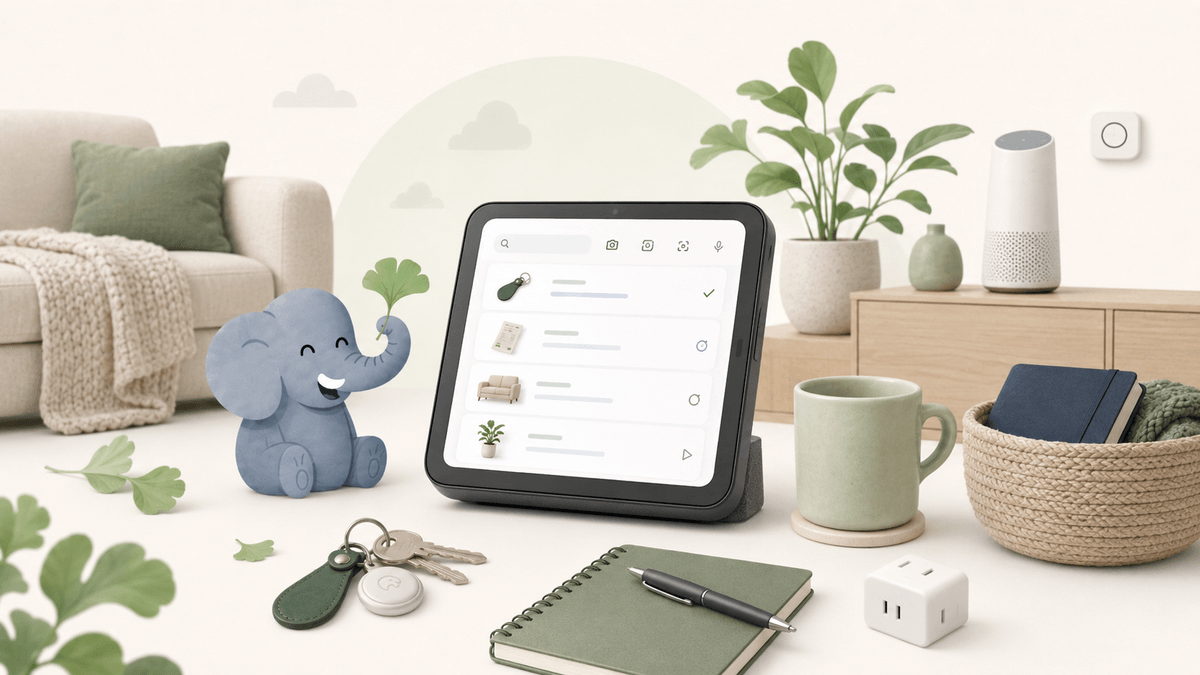
We thought about this carefully when designing Ginkgo. The current app uses AI for photo recognition because it can reduce the work of adding items. We are interested in richer retrieval and smarter matching over time, but we do not use AI to make decisions about what is important, predict what you will need, or reorganise your space, because the value would be unreliable.
The goal is an app where the AI does the work that’s tedious, not the work that’s subtle. That distinction, we think, is the difference between AI that quietly improves your life and AI that occasionally frustrates it.
Frequently asked questions
Is AI useful for home organisation?
Yes, when it helps you add and find information faster. AI is especially useful for photo recognition, natural language search, voice notes and matching vague descriptions to real items.
What is the biggest problem with AI at home?
The biggest problem is context. Homes are full of shared habits, personal preferences and exceptions. AI can help with retrieval, but it should not pretend to fully understand the household without good data.
Should I trust AI to organise my home?
Trust it with small tasks first. Let it identify, search, summarise and suggest. Keep final decisions with the people who actually live in the home.