
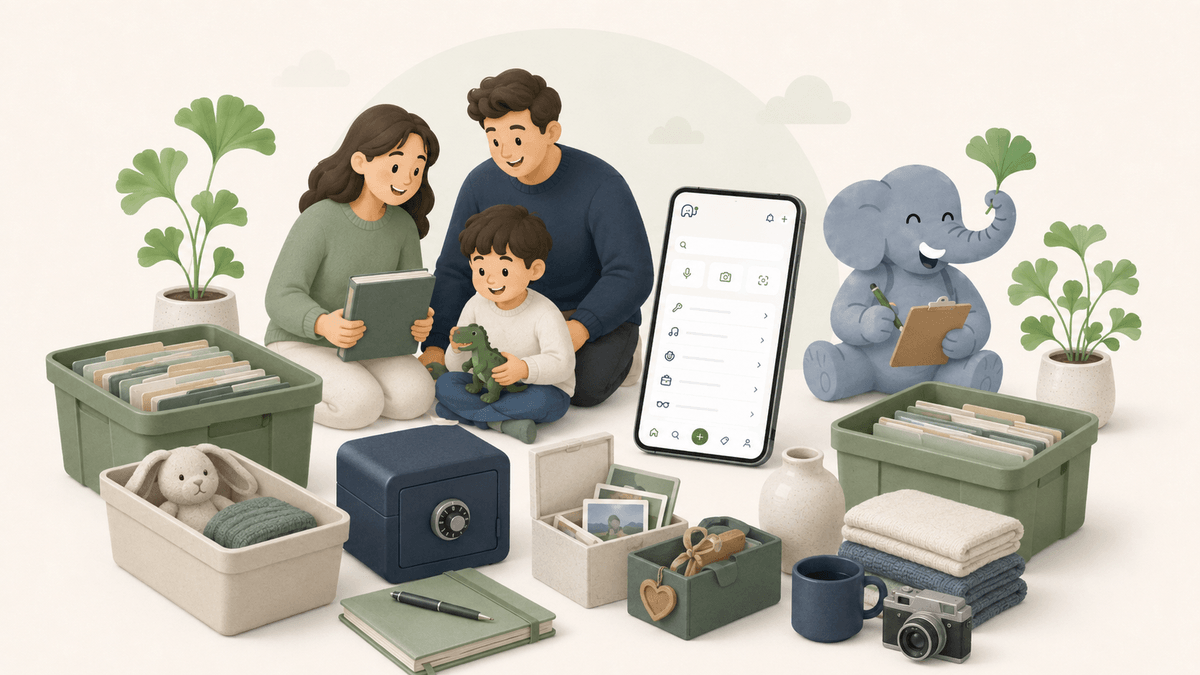
There are two types of household inventory advice online. The first is aspirational: colour-coded spreadsheets, room-by-room audits, annual reviews. The second is theoretical: articles that describe the concept without getting into the reality of getting three children and a partner to actually engage with a system.
This is neither of those. This is a guide for households where the inventory has to work in real life, with real people who have varying levels of enthusiasm for the project.
Why bother?
Before getting into the how, it is worth being clear about the why, because a vague motivation leads to a system that gets abandoned.
The core problem a household inventory solves is search time and coordination friction. In a household with multiple people, everyone carries a slightly different mental model of where things are. When you need something, you either know where it is (if it was you who last used it) or you ask around (if it wasn’t). The asking around is the friction. Multiply it over a year and you have a surprising amount of time and irritation.
A shared inventory makes the map explicit. Everyone can access it. Updates are shared automatically. The answer to “where is the X?” becomes: look it up.
Secondary benefits include insurance documentation, knowing when to replace things, and not buying duplicates of things you already own but could not find.
The quick answer
A family home inventory works best when it starts small, focuses on shared or hard-to-find items, and takes less than thirty seconds to update. You do not need to document every spoon, book or sock. You need a reliable record of the things people actually look for.
The best first version is simple: item, photo, location, notes and who might need it. Once that is useful, you can expand.
Start smaller than you think you should
The biggest mistake people make with household inventories is trying to document everything at once. The resulting project is so large that it never gets finished, or gets finished once and never maintained.
A better approach: start with the things that cause the most friction.
Ask your household: what are the five things we look for most often that we can never find? Start there. Document those five things, make sure everyone knows how to access and update the information, and let that become the habit. Once the habit is established, adding more items is easy.
This might feel frustratingly small. But a five-item inventory that’s always accurate and always accessible is worth more than a five-hundred-item inventory that’s three months out of date.
The participation problem
Getting buy-in is the hardest part of any shared system. A few things help:
Make it easier to use than not to use. If contributing to the inventory requires more effort than just remembering where something is, it will not happen. The friction of updating has to be genuinely minimal, ideally a photo and a voice note. Not logging into a website and filling in fields.
Tie it to existing moments. The most natural time to record an item’s location is when you’re putting it away. Make that the trigger: when something goes away, update the inventory. This takes about ten seconds with the right tool.
Let people contribute in their own way. Some people will want to be thorough and structured. Others will just want to ask questions and get answers. A good system serves both. Don’t require everyone to engage the same way.
Be prepared to be the person who maintains it initially. In most households, one person cares more about the system than others. That is fine. The value delivered to the household is what creates adoption, not expecting people to maintain a system that does not yet benefit them.
What to include (and what to leave out)
Not everything needs to be in a household inventory. The things that benefit most are:
- Items that are used infrequently (and therefore harder to remember the location of)
- Items that live in non-obvious or multiple locations
- Items that multiple people need to find independently
- High-value items (useful for insurance purposes)
- Seasonal items
- Consumables that need regular replenishment
The things that probably don’t need to be in the inventory:
- Items that have a permanent, obvious, singular home that everyone knows
- Very high-frequency items (if you use it every day, you know where it is)
- Disposable items with short lifespans
The goal is a useful inventory, not a complete one. Completeness for its own sake adds maintenance burden without adding value.
Keeping it current
An inventory that is out of date is worse than no inventory. It creates false confidence and costs you time when it turns out to be wrong.
The key to currency is making updates easy and making the trigger clear. The trigger should be: any time an item moves, the inventory gets updated. Not a weekly review, not an annual audit. At the moment of movement.
This requires the tool to be fast enough that this is realistic. If updating takes more than thirty seconds, it won’t happen routinely.
It also helps to have a way to flag items as “not sure where this is” rather than removing them. Uncertainty is useful information. It tells other household members to ask rather than look up.
A note on children
Children complicate household inventories in two ways: they move things, and they’re the ones most often asked where things are.
The first is a maintenance challenge. The second is actually an opportunity. Children who understand the household inventory and can contribute to it are developing a genuinely useful life skill: the habit of knowing and recording where things live.
For younger children, contributing can be as simple as showing something to the camera after tidying. For older children, giving them ownership of their own section of the inventory, such as their bedroom or sports equipment, is a reasonable starting point.
The goal isn’t perfection. It’s building the reflex that where things live is worth recording.
The maintenance reality
Everything above describes a system in steady state. Getting there requires some initial effort: going through the relevant areas of your home, documenting what’s there, creating the categories that work for your household.
The honest advice: block two or three hours on a Saturday morning. Do one area of the home properly. Let that be the foundation. Add more when you have time and inclination.
Done is much better than perfect. An inventory of fifty items, well maintained, beats a thousand-item inventory that nobody trusts.
A simple room-by-room starting list
If you are not sure where to begin, use this list:
- Hallway: keys, spare keys, bags, umbrellas and school items
- Kitchen: appliance manuals, special tools, spare parts and rarely used equipment
- Utility space: cleaning products, batteries, bulbs and repair supplies
- Bedrooms: documents, jewellery, seasonal clothes and sentimental items
- Garage or shed: tools, cables, sports kit, paint, garden equipment and decorations
This is not a checklist to complete in one weekend. It is a way to spot the items that cause the most confusion.
Frequently asked questions
What should be included in a family home inventory?
Include shared items, expensive items, seasonal items, important documents, tools, chargers, spare parts and anything people regularly ask about. Skip obvious everyday items unless they often go missing.
How do you keep a household inventory up to date?
Update the record when the item moves, not at the end of the week. The update has to be quick enough that people can do it in the moment.
Is a spreadsheet good enough for a home inventory?
A spreadsheet can work for one person, but families usually need something easier to search and update on a phone. Photos, familiar wording and simple routines make the system much more likely to stick.