
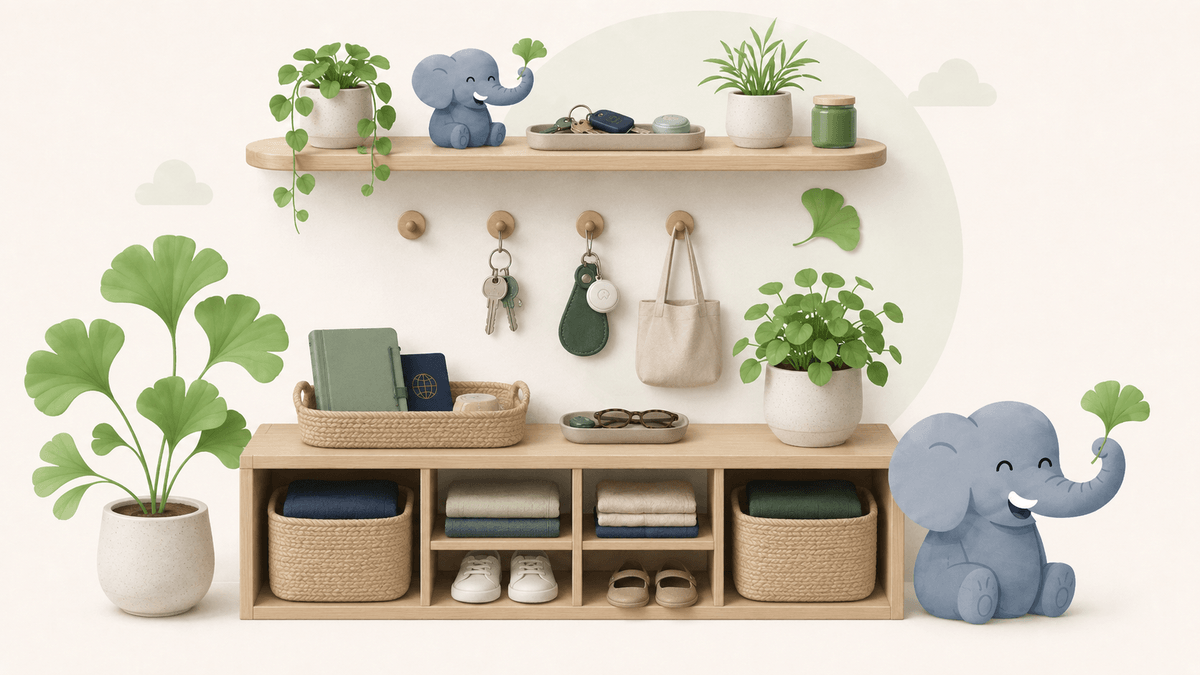
Every January, home organisation products sell out. Drawer dividers, label makers, stackable boxes. People tear out their cupboards and start fresh. By February, the boxes are full of random things and the drawer dividers have shifted to one corner.
It’s not a motivation problem. It’s a systems design problem.
The quick answer
A home organisation system sticks when it fits your real behaviour, not your ideal behaviour. The best systems make the right action easy, create obvious homes for the things you use most, and give exceptions somewhere to go.
If you want a calmer home, do not start by reorganising everything. Start with the three places where friction shows up most often: the items you lose, the piles that keep forming, and the shared things nobody can find without asking.
Why most systems fail
The typical approach to home organisation is to start with a vision of an ideal state, such as a perfectly labelled kitchen or an immaculate wardrobe, and work backwards. The result looks great in photos. It rarely survives contact with real life.
Real life includes tired Tuesday evenings when the thought of opening the correct drawer feels like too much. It includes children who do not share your taxonomy. It includes partners who have different mental models of where things belong. It includes the unpredictable: the new purchase that does not fit anywhere, the temporary thing that becomes permanent.
A system that only works when everyone is well-rested and fully cooperative is not a system. It is a set of aspirational rules.
The principle of minimum viable friction
The most durable home organisation systems have one thing in common: they make the right behaviour the easy behaviour.
Not easier than doing nothing, because that is asking too much. But easier than the alternative. If putting your coat on the hook by the door is more convenient than dropping it on the chair, the hook wins. If the charging cables have a dedicated spot that takes two seconds to use, they will end up there.
This is why zones matter more than labels. A zone, meaning a physical area designated for a category of things, has lower cognitive overhead than a specific labelled container. “Kitchen things go in the kitchen” is a rule almost anyone can follow. “The garlic press lives in the third drawer from the left” is a rule that requires recall.
Work with your actual behaviour, not your ideal behaviour
This one is uncomfortable to acknowledge, but crucial: build your system around what you actually do, not what you think you should do.
If you always drop mail on the kitchen counter before sorting it, do not fight that. Put a tray on the kitchen counter. You have not surrendered to chaos. You have integrated reality into your design.
If you always leave your bag by the front door, give it a proper spot there. If the children always empty their pockets onto the hall table, make the hall table the official pocket-emptying station.
Sustainable systems have a tolerance for human imperfection built in. The question to ask is not “where should this go?” It is “where does this actually tend to end up, and how can I make that location work?”
The problem of exceptions
No category is perfectly clean. There are always exceptions: the thing that does not quite fit anywhere, the seasonal item, the object that belongs to a project rather than a place.
Most organisation systems break down at exceptions, because there’s nowhere good to put them. They end up in a “miscellaneous” pile, which grows until it becomes the dominant category.
The better approach is to build exceptions into the system from the start. A small catch-all zone in each room, not hidden away but acknowledged and intentional, gives exceptions a home. When the zone fills up, that is the trigger to sort it.
The role of memory and search
Here is something that does not come up enough in conversations about home organisation: it is not just about putting things away. It is about finding them again.
A perfectly organised home is one where retrieval is as frictionless as storage. You do not just know where everything goes. You can recall where everything is.
This is where physical organisation has natural limits. You cannot keep the entire map of your home in your head. Categories and zones help, but they have real cognitive overhead.
This is one of the things Ginkgo is designed for: not to replace a physical organisation system, but to complement it. It can hold the parts of the map you cannot reliably hold in your head, such as the location of the seldom-used item, the temporary exception, or the thing you put somewhere unusual while renovating.
A practical starting point
If you are building or rebuilding a home organisation system, here is what tends to work:
Start with the pain points. Do not try to reorganise everything at once. Pick the three things that cause the most friction in your daily life, such as the things you look for most often or put away least reliably, and fix those first.
Then let the system tell you what it needs. After a month, notice where things pile up. Notice what never gets put away. Notice what gets moved from its designated spot. These are signals, not failures. They are showing you where the system needs to adapt.
Organisation is not a project you complete. It is an ongoing conversation between how your life works and how your space is set up. The goal is not perfection. It is something more modest and more valuable: a home that puts up less resistance.
A simple calm-home reset
Try this if your home feels cluttered but you do not know where to start:
- Choose one high-friction zone, such as the hallway, kitchen counter or utility drawer.
- Remove anything that obviously belongs elsewhere.
- Notice what keeps returning to that spot.
- Create an intentional home for those things nearby.
- Record the location of anything rare, shared or easy to forget.
This works because it treats clutter as information. A pile is not always a failure. Sometimes it is your home telling you where a system is missing.
Frequently asked questions
How do I make a home organisation system last?
Make it easy to maintain on tired days. Use simple zones, visible homes, fewer rules and a quick way to record exceptions.
Why do most home organisation systems fail?
They are often designed for an ideal version of life. Real homes include rushing, sharing, children, visitors, new purchases and forgotten exceptions. A good system expects all of that.
What is the first step to a calmer home?
Start with one repeated friction point. Fix the thing you look for most, the pile that keeps coming back, or the shared item that always causes questions.